
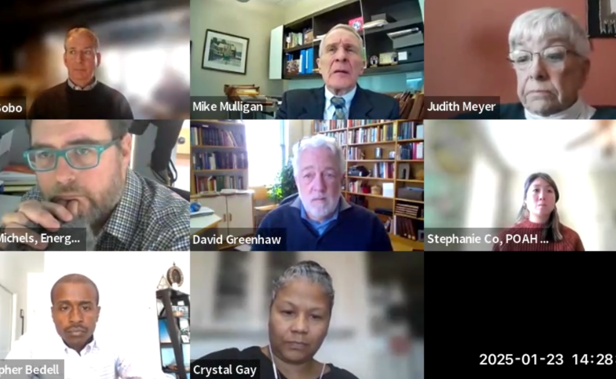
A little bit of news, last month (on January 23rd, 2025), at the recommendation of the Office of Building Performance (OBP), St. Louis’s Building Energy Improvement Board (BEIB) approved the first Custom Alternative Compliance Plan (CACP), one we had done for 625 S. Skinker Condo Association. This is a custom application for buildings that cannot hit the Building Energy Performance Standard (BEPS) established by the 2020 ordinance. It includes an energy audit, a plan for improvements, and explanations of why the best plan forward for energy investments in the building do not allow it to hit the BEPS targets within the first cycle.
Congrats to 625 Skinker, the BEIB/OBP, and to ERG for passing this milestone!
At the end of the board meeting, the OBP mentioned that there are several other CACPs in the works, but to date, none are yet complete and ready for review.
Above are the highlights of the approval. (3:46) You can also view a longer version of the BEIB meeting which contains all the content relevant to the CACP approval process. (9:30).
The public comments from resident board members of 625 South Skinker also illustrated an important part of the BEPS compliance process. New requirements can initially produce uncertainty or resistance, particularly when building owners do not yet understand what compliance will require or how much it may cost. Dr. David Greenhaw, a member of the 625 South Skinker board and capital planning committee, described how the community’s response evolved as it worked through from anxiety over BEPS to understanding and confidence:
It caused some anxiety among some of us. “We’re not doing that. They can’t do that to us,”
to, “This really makes sense for us, and we need to be thinking and working this way.”
Another member, Judith Meyer said:
“I would just like to thank Aaron for his thoughtful leadership on this.
We brought him in as a consultant, and he made a big difference to us
in terms of both understanding what the issues were and helping us devise a plan.”
BEIB meetings are open to the public, you can find out more about them at:
Transcript of Board Meeting Highlights:
Katerina Michalova, Director of the Office of Building Performance:
I would like to speak for the Technical Subcommittee. We already checked this plan multiple times. All seems satisfactory to me on all the points. This plan is written very well, and I propose to the Technical Subcommittee to approve this plan and make a recommendation to the board to approve it.
Vice Chair, Mary Ann Lazarus:
I don’t know how many people have had a chance to look at the document. It was very thorough. I did actually read it—I want you to know. Very detailed analysis of different energy-efficiency measures that could be applicable to this particular building and its cost-benefit ratios, et cetera. Any conversation? Any questions? Any thoughts as we—
Member Brian DiCarlo:
Yeah, I agree with Katarina. It’s professionally done, and it outlines all the deficiencies and solutions—proposed solutions—even down to a timeline. I mean, I can’t argue with this one. It’s a good report.
Vice Chair:
Thank you, Member DiCarlo, in your capacity, that’s very appreciated. Anybody else? Any comments?
All right. So, again, I motion to accept the CACP for 625 South Skinker. All in favor, say aye.
Members:
Aye.
Vice Chair:
Any opposed? (pause, silence)
Excellent. So moved. I think this is a great way to start off our CACP process.
All right. Now we actually have comments from members of the public. Before we do that, I again want to thank the members of the 625 South Skinker community for coming today and showing your support for this process that we’re going through. It’s really important as a driver for changing the energy use within our city and region.
Dr. David Greenhaw, 625 S. Skinker Board Member:
My name is David Greenhaw. I’m a member of the 625 South Skinker board. I just want to describe, for your ongoing work, the evolution of our reaction to this.
That is, it’s a new thing. Suddenly, we found that there are rules and regulations and proposals and ways that we needed to respond. It caused some anxiety among some of us. We were greatly helped by having ERG help us, and we were able to allay a lot of our anxiety by having some conversations with Katarina.
I think the evolution of our process, was from some people saying, “We’re not doing that. They can’t do that to us,” to, “This really makes sense for us, and we need to be thinking and working this way.”
Not only is it socially responsible, but it’s economically appropriate for a building, and it can enhance both the experience of our living in this building and for our community.
So, I think it’s an adjustment for folks. If at any time we can be helpful with neighbors on that, we’d be happy to do what we can.
I believe—at least—that our building will be able to develop further and further refined plans, and meet our deadlines, and be better for it. So, I appreciate the effort you’ve done and your willingness to stumble along with us as we try to do this as well. I just want to express our gratitude for that.
Judith Meyer, 625 South Skinker board member:
I would just like to thank Aaron for his thoughtful leadership on this. We brought him in as a consultant, and he made a big difference to us in terms of both understanding what the issues were and helping us devise a plan.
And I know one of his goals was to be, in fact, the first one that you saw, because he felt that we could provide a model because we were working effectively with him.
But I just—I want to thank him in particular for the work he did for us.
Vice Chair:
Thank you so much. We have gotten through the agenda and have made a recommendation to approve the CACP for 625 South Skinker.
Those are wonderful comments—all of them. And I think it’s really exciting to hear your willingness to maybe serve as a case study, or some way of communicating the process you’ve been through, and the ups and downs, and where you’ve landed.
I think that would be an excellent communication opportunity for the board and the OBP—the Office of Building Performance—as we launch this next phase.
So, really appreciate your comments. Thank you so much.


